Jordan Loewenstein, D.C. | La Jolla Chiropractor
San Diego's
Posture
Chiropractor
Tech neck, rounded shoulders, desk back pain, student posture problems — care that treats the actual cause, not just the symptom. Serving La Jolla, UTC, and students near UCSD, USD, and SDSU.
Yes, chiropractic care helps posture-related pain from long hours at a desk or phone. Dr. Loewenstein addresses the tight and weak muscles behind common posture patterns, combining hands-on treatment with corrective exercises and ergonomic guidance. Most people feel looser within a few visits, with lasting change taking consistent work.
Your Posture Is Talking. Are You Listening?
That stiff neck you wake up with. The tension headache that creeps in by 2pm. The low back ache that settles in after a full day on a laptop. These aren't random. But the cause is probably not the shape you sit in — it is how long you hold any one shape, and whether the muscles behind you are strong enough for the job.
In San Diego's UTC and La Jolla corridor, we see it every day: UCSD students hunched over MacBooks in Geisel Library, remote workers slouched at kitchen tables, tech employees with shoulders rolled forward from years of screen time. Posture problems are not a character flaw — they're a structural response to modern life.
The good news is that this responds well, and not because we straighten you out. Randomized trials of corrective exercise programs in desk workers reliably reduce neck and shoulder pain over about eight weeks — and notably they improve pain more than they change posture itself, which tells you what is actually doing the work. With adjustments and soft tissue work to settle the joints down, and loading to build the endurance behind it, most patients feel a real difference in four to eight weeks. The target is a stronger, more mobile spine that changes position often. It is not sitting like a soldier.
What's Actually Going On
Every posture condition has a specific pattern of tight muscles, weak muscles, and restricted joints. Here's what's happening in your body — and how we fix it.
Tech Neck
Your head weighs about 10 to 12 pounds, and holding it forward of your shoulders does ask more of the muscles at the back of the neck. You have probably seen the claim that this becomes a 60-pound load. That number comes from a computer model, not from measuring anyone — and cadaver testing has shown cervical spines tolerating many times that before anything gives. Necks are far more robust than the graphic going around suggests.
What does hold up is the endurance side. Hold any position for hours a day and the muscles at the front shorten while the ones behind you switch off — that part is measurable, and it is what the upper crossed pattern describes. Over months the joints get stiff, the deep neck flexors stop pulling their weight, and pain starts showing up in places that feel unrelated: tension headaches, shoulder tightness, sometimes symptoms into the arm. The fix is strength and variety, not a perfect head position.
Upper Crossed Syndrome
Upper Crossed Syndrome (UCS) is a specific pattern of muscular imbalance that develops when certain muscles become chronically overworked and tight — the upper trapezius, levator scapulae, and pectoralis minor — while opposing muscles become inhibited and weak — the deep cervical flexors, lower trapezius, and serratus anterior.
The result is the classic "desk worker" posture: forward head on top of rounded, internally rotated shoulders with a collapsed upper back. San Diego's laptop-in-a-coffee-shop culture is a textbook culprit. It's also extremely common in surfers and swimmers due to the repeated shoulder loading pattern.
Lower Crossed Syndrome
Lower Crossed Syndrome (LCS) is the lower-body counterpart to UCS. The hip flexors (iliopsoas) and lumbar erectors become tight and overactive, while the glutes and deep core muscles (transverse abdominis) become weak and inhibited. The pelvis tips forward, the lumbar curve exaggerates, and your low back takes the load that your glutes and core were supposed to share.
Sitting for hours in lectures, cars, and in front of computers keeps the hip flexors in a chronically shortened position. Over a semester — or a career — those hip flexors "forget" how to fully lengthen, and the glutes forget how to fire properly.
Hyperkyphosis
Hyperkyphosis is an exaggerated forward curve of the thoracic spine — your upper and middle back rounds outward more than normal. You might know it colloquially as a "hunchback" posture. The thoracic spine is designed to have a gentle outward curve; hyperkyphosis is what happens when that curve becomes excessive and structural changes start to set in.
Unlike scoliosis, which is a sideways curve, hyperkyphosis is a sagittal-plane problem that responds well to chiropractic care when caught before significant structural changes occur — which is exactly why treating it in your 20s and 30s is far easier than waiting until your 50s.
Anterior Pelvic Tilt
Think of your pelvis as a bowl of water. Anterior pelvic tilt is when the front of the bowl tips down and the water spills forward — the tailbone lifts up and back, the lumbar curve increases, and your low back joints take pressure they weren't designed to handle for 8 hours a day. It's one of the most common postural findings in young adults, especially those who sit most of the day.
The underlying cause is almost always the same: tight hip flexors from sitting combined with inhibited glutes and abdominals that can't provide the opposing pull to keep the pelvis level.
Text Neck
Text neck is a subtype of forward head posture caused specifically by looking down at a smartphone. The average person checks their phone 96 times per day — and with the head dropping to 60 degrees of forward flexion while scrolling, the cervical spine is experiencing forces equivalent to 60 lbs in that position. Over thousands of daily repetitions, the structural damage accumulates.
This is particularly prevalent in the 18–30 age range, where social media use, texting, and phone-based entertainment occupy several hours per day — often layered on top of laptop use at school or work.
Backpack Strain
UCSD, USD, and SDSU students often carry laptops, textbooks, water bottles, gym gear, and supplies across large campuses — sometimes for hours. An overloaded bag pulls the spine into lateral flexion or excessive forward lean with every step. One-shoulder carrying — messenger bags, totes, single-strap bags — creates uneven loading on the trapezius and can produce functional scoliosis patterns.
Research shows over 79% of students report musculoskeletal pain related to bag-carrying habits. It's not that students need to carry less — it's that most have never been told how to carry correctly.
How We Fix It
Posture correction requires addressing three things simultaneously: the joints that have lost mobility, the muscles that are too tight, and the muscles that are too weak. Here's how each piece fits together.
Why San Diego Has a Posture Problem
San Diego is one of the most active cities in the country — morning surfs at Blacks Beach, trail runs through Torrey Pines, beach volleyball at La Jolla Cove. But physical activity doesn't cancel out poor posture. In fact, surfing creates a specific upper crossed pattern from the paddle position. Cycling drives hip flexor tightness. The same San Diegan who surfs at 7am may sit at a laptop from 9 to 5 in between — and those 8 hours of screen time win.
UTC and La Jolla have a high concentration of tech workers, startup employees, and young professionals who work from home — a population hit especially hard by remote work's ergonomic chaos. Kitchen tables, couches, and beds are not workstations. They're posture destruction environments used for 40+ hours a week.
San Diego's three major universities bring together tens of thousands of students in exactly the environments that produce postural dysfunction — and we're right in the middle of it at UTC.
8 Tips That Actually Work
Practical, specific, and free. These are the changes that make the biggest difference between visits — for students and desk workers alike.
Posture & Chiropractic FAQs
Answers to the questions patients and students ask most — honest, direct, and without the fluff.
Yes — but "fix" is the right word only if you're also willing to do some work outside the office. A chiropractor addresses the structural and muscular contributors: restricted joints get adjusted, tight muscles get released, and weak muscles get targeted with corrective exercise. What chiropractic alone can't do is override 8+ hours of daily sitting that caused the problem. The most successful outcomes combine in-office treatment with ergonomic changes, specific exercises, and consistency. Most patients notice improved mobility and reduced pain within 4–8 visits.
Posture that developed over years takes time to correct — there's no shortcut. In practice, patients typically notice pain relief within 2–4 weeks. Visible posture improvements usually emerge between 4–12 weeks of consistent care, depending on how long the pattern has been established. A 22-year-old student who's been on a laptop for 4 years will typically correct faster than someone in their 40s with a decade of desk work. Realistic expectation: meaningful improvement in 6–12 weeks with maintenance care sustaining results long-term.
Tech neck is the forward-head posture that develops from spending hours looking at screens positioned below eye level. When the head drifts even 2 inches forward, the effective load on the cervical spine jumps from about 12 lbs to over 30 lbs, straining the muscles, joints, and discs. Chiropractors treat tech neck through cervical and thoracic adjustments, Active Release Technique on the fibrotic muscles in the back of the neck, and corrective exercises (chin tucks, thoracic extensions) that address the root cause.
Absolutely. Cervicogenic headaches — headaches that originate from the neck — are extremely common in people with forward head posture and upper crossed syndrome. Tight suboccipital muscles at the base of the skull and restricted upper cervical joints refer pain directly into the head, often mimicking tension headaches or migraines. Chiropractic adjustments of the upper cervical spine, combined with soft tissue release of the suboccipital and upper trapezius, often provide rapid relief. Studies have shown spinal manipulation to be as effective as common migraine medications for cervicogenic headaches — without the side effects.
It's one of the most effective interventions for this exact problem. Prolonged sitting compresses thoracic joints, tightens the thoracic erectors and pec muscles, and inhibits the muscles that hold the shoulder blades back. Chiropractic adjustments restore joint mobility in the thoracic spine, reducing that stiff, locked-up feeling after hours at a desk. Combined with soft tissue work and targeted mid-back strengthening, most desk workers see significant improvement. Many patients report feeling taller and breathing more easily after thoracic adjustments — the rib cage can expand more freely when those joints move properly.
Remote work has created a posture epidemic. Without a proper ergonomic office setup, most people work for 6–10 hours at kitchen tables, couches, or beds — all posturally disastrous environments. Chronic neck stiffness in WFH workers is almost universally driven by forward head posture, upper crossed syndrome, or both. Chiropractic directly addresses the cervical and thoracic joint restrictions, muscle tightness, and nerve tension that produce that stiffness. Most WFH patients with neck pain see significant improvement within 2–4 weeks of starting care, especially with simultaneous ergonomic changes.
Stand naturally against a wall. Your head should touch the wall comfortably with both shoulder blades and buttocks making contact. If your head is more than 1 inch from the wall, or if you have to strain to make contact, you likely have measurable forward head posture. A side-profile photo is even clearer: draw a vertical line through the earlobe — it should pass through the shoulder joint. If the earlobe is forward of the shoulder, that's FHP. A formal postural assessment here gives you an exact measurement to track improvement over time.
Yes — chiropractic is widely considered one of the safest forms of musculoskeletal treatment available, and it's especially appropriate for young adults. Younger patients tend to respond faster because their tissues are more adaptable and postural patterns haven't been as deeply ingrained. Cervical and lumbar adjustments for a healthy 18–25 year old are gentle, well-tolerated, and carry an extremely low risk profile when performed by a licensed chiropractor.
Sustained sitting places up to 40% more pressure on the lumbar discs than standing does. After an hour or two, the lumbar erectors and hip flexors fatigue and tighten while the core muscles disengage. The pelvis tips forward, the lumbar curve increases, and the facet joints become compressed. Many students also crane forward toward lecture screens or look down at notes, compounding the cervical and thoracic loading. The pain after class is your body signaling that those structures are loaded, compressed, and overdue for movement.
Yes. Anterior pelvic tilt is a muscle imbalance issue — tight hip flexors and lumbar extensors pulling the pelvis forward, weak glutes and core failing to resist it. Chiropractic addresses both sides: lumbar and pelvic joint adjustments restore mobility, while targeted soft tissue work (especially psoas release with ART) lengthens the tight hip flexors. The correction that sticks is the corrective exercise: glute activation, core strengthening, and hip flexor stretching done consistently outside the office. Many patients see meaningful changes within 6–8 weeks.
ART is a hands-on soft tissue method that treats problems in muscles, tendons, fascia, nerves, and ligaments. The practitioner applies precise tension to a specific tissue while you move through a range of motion — this combination breaks down adhesions, releases entrapped nerves, and restores normal tissue glide. For posture patients, ART is particularly effective on the suboccipitals (tech neck), pec minor (rounded shoulders), iliopsoas (anterior pelvic tilt), and piriformis. Sessions are brief — 5–15 minutes per area — and many patients feel a difference in the same visit.
The guideline is 10% of your body weight — so for a 150 lb student, that's 15 lbs. Research shows backpacks exceeding this threshold increase forward lean, reduce the craniovertebral angle, and are associated with higher rates of neck and back pain. A 2024 study found over 80% of students carry bags exceeding the recommended weight. Practical tips: carry only what you need for that day, always use both straps, position the bag high and close to your back, and consider a rolling bag for heavy load days.
Raise your laptop screen to eye level using a stand or books, use an external keyboard and mouse, keep your feet flat on the floor, take a 5-minute movement break every 45 minutes, and squeeze your shoulder blades together periodically. Never study lying on your stomach with your head turned to one side — it puts the cervical spine in sustained rotation for hours. These five changes, applied consistently, dramatically reduce your postural loading during long study sessions.
The college years are when postural habits are formed. Addressing poor posture at 20 is dramatically easier and cheaper than addressing it at 40 — both in terms of treatment time and the long-term cost of untreated postural dysfunction, including disc degeneration and chronic pain. We accept most major insurance plans including student plans, and initial consultations are straightforward. UCSD, USD, and SDSU students can check whether their plan covers chiropractic — many do. Ask about your options when you call or book online.

One doctor.
Every visit.
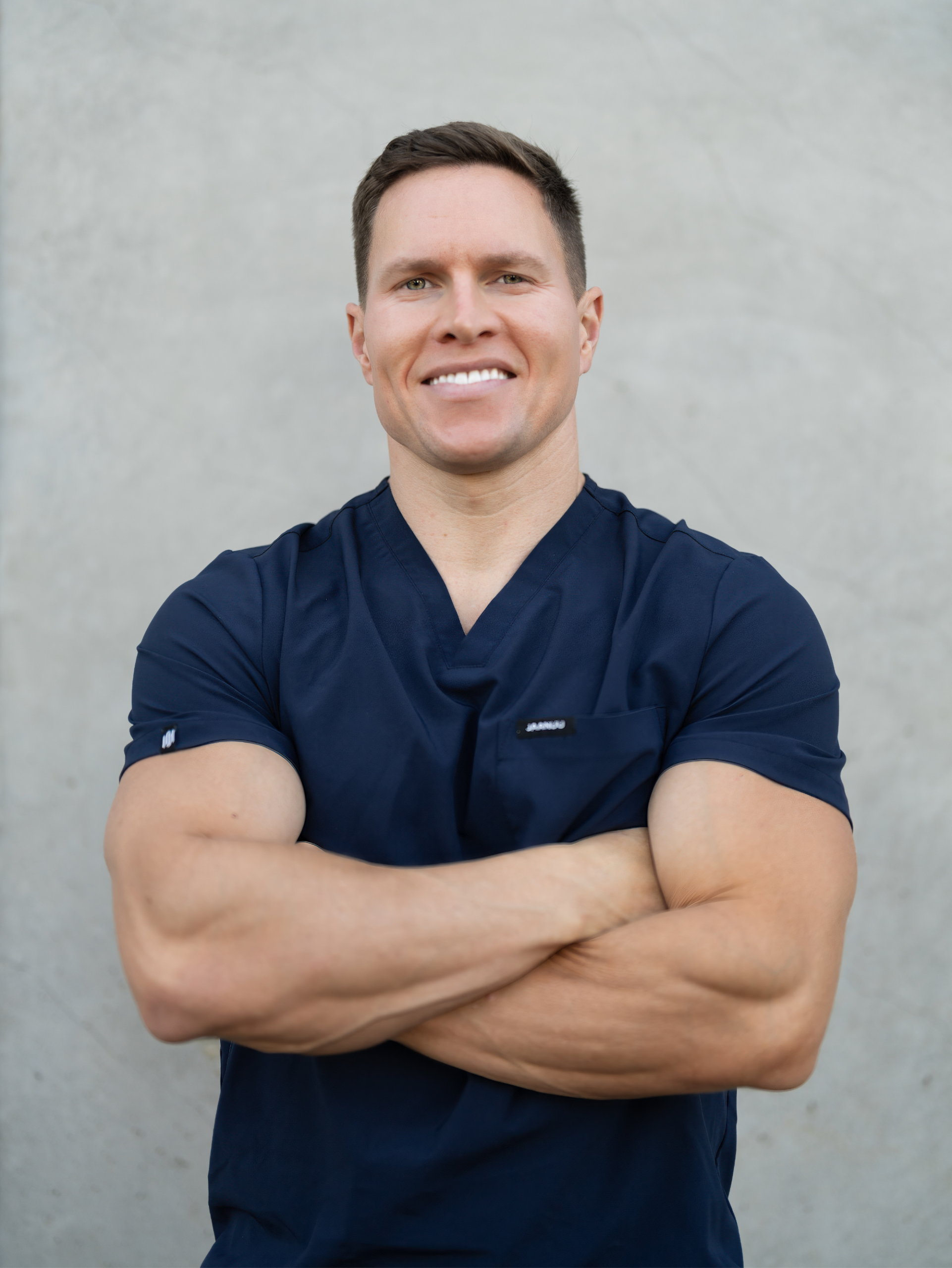
You will see Dr. Jordan Loewenstein at every appointment. Not an associate, not a rotating schedule of providers, not a five-minute pass-through. Forty-five minutes on your first visit, thirty on follow-ups — one-on-one, start to finish.
He holds a Master’s in Nutrition alongside his Doctorate of Chiropractic, which matters when a recovery stalls and the answer is in how you are sleeping, eating, or loading the tissue between visits.

Isn't Permanent.
Most patients feel a difference within the first few visits. Whether you're a UCSD student with backpack strain or a remote worker with a locked-up neck — this is fixable. Let's find out what's actually going on.