Jordan Loewenstein, D.C. | La Jolla Chiropractor

Exercise & Stretch Library

Shoulder Pain
Stretches &
Exercises

Clinician-recommended mobility stretches and rotator-cuff exercises to relieve shoulder pain — plus the dos & don’ts that matter and how chiropractic care helps when self-care isn’t enough. From a San Diego practice that finds the cause first.

Clinician-Recommended
Rotator Cuff Focused
UTC San Diego — Near UCSD
Motion First
Pendulums before pushing
Strengthen the Cuff
Band work rebuilds the shoulder
Stay Pain-Free
Work the range that doesn’t hurt
Know the Red Flags
Can’t lift it? Get seen

What Helps
Shoulder Pain

The best moves for shoulder pain gently restore motion, then strengthen the rotator cuff and shoulder-blade muscles — pendulums, cross-body and sleeper stretches, then resistance-band external rotation and scaption. Most rotator-cuff and impingement pain improves with the right movement. If you can’t lift the arm at all, or the pain followed a fall or dislocation, get evaluated.

2nd
most common joint complaint after the lower back
70%
of shoulder pain involves the rotator cuff or impingement
#1
exercise is the cornerstone of most non-surgical shoulder recovery
6–12
weeks of consistent rehab for many rotator-cuff and impingement cases

Most shoulder pain comes from the rotator cuff and the surrounding soft tissue — irritation, impingement, or tightness rather than serious damage. The shoulder is built for mobility, so it relies heavily on those muscles for stability, and when they get overloaded or weak, pain follows.

The path back has two stages: first restore comfortable motion, then rebuild strength and control. The stretches below gently free up a stiff or guarded shoulder, and the exercises strengthen the rotator cuff and shoulder-blade muscles that keep the joint centered and pain-free.

Work within a pain-free range and progress gradually. Some muscle fatigue is fine; sharp pain, or pain that lingers afterward, means back off. If you can’t actively lift the arm or you feel weakness, read the “when to see a professional” section below. This page is a starting point, not a diagnosis.

Start with Motion
Gentle pendulums and slides come before loading. Restore the range first, then add resistance.
Light Band, More Reps
Rotator-cuff work responds to light resistance and good form — not heavy weight.
Check the Neck Too
Shoulder and upper-arm pain can refer from the neck — especially with tingling past the elbow.

Recommended
Stretches

Gentle mobility work to free up a stiff or guarded shoulder. Start with pendulums, keep everything pain-free, and never force overhead. Tap any card to watch a demo.

Codman pendulum shoulder exercise demonstrationWatch demo
01
Codman Pendulum
Lean forward with your good arm on a table and let the sore arm hang and swing in small gentle circles. Gravity mobilizes the joint without you having to use the painful muscles.
10 circles each way · 2x
Cross body posterior capsular shoulder stretch demonstrationWatch demo
02
Cross-Body Stretch
Bring the sore arm across your body and gently draw it closer with the other hand. Stretches the back of the shoulder, a common tight spot with impingement.
Hold 20–30s · 2–3x
Shoulder sleeper stretch demonstrationWatch demo
03
Sleeper Stretch
Lying on the sore side with the arm out front, gently rotate the forearm down toward the bed. Improves internal rotation — go easy and stop at a mild stretch.
Hold 20–30s · 2–3x
Table slides shoulder scaption demonstrationWatch demo
04
Table Slides
Seated with hands on a towel on a table, slide your arms forward and up to raise the shoulder within a comfortable range. A gentle, supported way to regain overhead motion.
8–10 slides · 2x
Doorway pec stretch demonstrationWatch demo
05
Doorway Pec Stretch
Forearms on a doorframe, step gently through to open the chest and front of the shoulders. Counters the rounded-forward posture that crowds the shoulder joint.
Hold 20–30s · 2–3x
Upper trapezius stretch demonstrationWatch demo
06
Upper Trapezius Stretch
Gently tilt one ear toward your shoulder to release the upper trap. Tight, overworked traps often tag along with shoulder pain and shrug the shoulder up.
Hold 20–30s · 2x each side

Recommended
Exercises

Strengthening the rotator cuff and shoulder-blade muscles is what keeps the joint centered and stops the pain coming back. Use a light band, good form, and stay pain-free.

Shoulder external rotation with band demonstrationWatch demo
01
Band External Rotation
Elbow tucked at your side and bent 90°, rotate your forearm outward against a band, then return slowly. The key rotator-cuff strengthener.
10–15 reps · 2–3 sets
Rotator cuff exercises with resistance band demonstrationWatch demo
02
Rotator Cuff Band Set
A short resistance-band routine for the full rotator cuff — internal and external rotation and more. Keep the band light and the movements smooth and controlled.
10–15 reps each
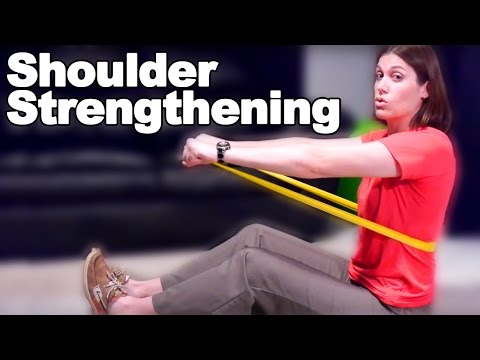
Shoulder strengthening with resistance band demonstrationWatch demo
03
Band Scaption & Rows
Band strengthening through the scaption and rowing patterns that build everyday lifting and reaching strength. Keep the shoulder blade set down and back.
10–12 reps each
Scapular squeeze exercise demonstrationWatch demo
04
Scapular Squeezes
Squeeze your shoulder blades together and down. A stable shoulder blade is the foundation the rotator cuff works from — this is the base of every shoulder program.
Hold 5s · 10 reps
Prone ITWY scapular strengthening demonstrationWatch demo
05
Prone I-T-W-Y
Lying face down, lift the arms into I, T, W and Y shapes, squeezing the shoulder blades each time. Builds the mid-back and shoulder-blade muscles that support the cuff.
5–8 reps each letter
7 great shoulder rehab exercises follow-along routineFollow along
06
Full Rehab Routine
Want it all in one place? Follow this guided shoulder rehab routine to move through the key strengthening exercises in order — a great progression as you improve.
Guided · 3–4x weekly
Shoulder not bouncing back on its own?
Book an Exam in San Diego

Dos &
Don’ts

The shoulder rewards patience and punishes pushing through pain. These habits help it recover — and the ones to avoid keep it irritated.

Do
Keep the shoulder gently moving — pendulums and pain-free range daily.
Strengthen the rotator cuff with a light band and good form.
Set the shoulder blade down and back before you lift or reach.
Use ice after activity if the shoulder is irritated or swollen.
Progress gradually — add reps and resistance only as pain settles.
Mind your posture — rounded shoulders crowd the joint.
Don’t
Push through sharp pain or pain that lingers afterward.
Do repeated painful overhead reaching or lifting during a flare.
Sleep directly on the sore shoulder — hug a pillow instead.
Jump back into heavy lifting or pressing too soon.
Let the shoulder go completely still — that invites stiffness.
Ignore an inability to lift the arm — that needs a professional look.

How Chiropractic
Helps Shoulder Pain

The shoulder and neck work as a unit, and shoulder pain can come from either. A proper exam sorts out what’s really going on so care actually lands.

01
Find the Source
An exam of the shoulder and the neck distinguishes rotator-cuff and impingement problems from pain referred from the cervical spine.
02
Restore Motion
Joint mobilization of the shoulder and the surrounding spine and ribs frees up the restricted, guarded movement.
03
Release Tension
Soft-tissue work and Active Release Technique calm the irritated rotator cuff and the tight muscles around the blade.
04
Rebuild Strength
You leave with the right cuff and scapular progression for your shoulder — so the relief holds up to daily life.
What the research says
For most rotator-cuff and impingement pain, structured exercise is as effective as surgery in many cases and is recommended first. Combining hands-on care with progressive cuff and scapular strengthening helps restore function and reduce pain.

When to See
a Professional

Most shoulder pain is mechanical and responds well to movement. But some signs mean you should be evaluated rather than push through. See a professional promptly if you have:

Inability to actively lift the arm (possible rotator-cuff tear)
Shoulder pain after a fall, dislocation, or significant injury
Obvious deformity, or the shoulder feeling like it slips out
Numbness or tingling running past the elbow into the hand
No improvement after a few weeks of self-care, or constant night pain
Redness, warmth, swelling, or fever around the joint
Seek urgent care for a shoulder injury with deformity after trauma, or sudden arm weakness with chest pain or shortness of breath.

Questions About
Shoulder Pain

The questions patients ask most about exercising with shoulder pain — answered directly.

What is the best exercise for shoulder pain?

For most shoulder pain, gentle pendulums and cross-body stretches to restore motion, plus resistance-band external rotation to strengthen the rotator cuff, are the best starting points. Build up slowly and stay within a pain-free range. If you can’t lift the arm at all, get evaluated first.

Should I rest or move a sore shoulder?

Gentle movement is usually better than complete rest. Keeping the shoulder moving within a comfortable range prevents stiffness and helps most rotator-cuff and impingement pain. Avoid the specific movements that sharply hurt, but don’t let the shoulder go completely still.

Are pendulum exercises good for the shoulder?

Yes. Pendulum (Codman) exercises use gravity to gently mobilize the shoulder without actively contracting the painful muscles, which makes them one of the safest early movements for a stiff or irritated shoulder. Keep the circles small and relaxed.

How long does rotator cuff pain take to heal?

Mild rotator-cuff irritation and impingement often improve over a few weeks with mobility and strengthening, while more stubborn cases can take a couple of months. If your pain isn’t improving, you have significant weakness, or you can’t lift the arm, get evaluated to confirm the cause.

Is my shoulder pain coming from my neck?

Sometimes. Pain felt in the shoulder and upper arm can actually come from the neck, especially when there’s tingling or numbness past the elbow or into the hand. A proper exam checks both the shoulder and the neck so treatment targets the real source.

Can a chiropractor help with shoulder pain?

Yes. A chiropractor can assess both the shoulder and the neck, mobilize restricted joints, release tight muscles, and guide rotator-cuff and scapular strengthening. Dr. Loewenstein performs a thorough orthopedic and neurological exam on the first visit at the UTC San Diego clinic.

Get Your Shoulder
Moving Again

These stretches are a great start. For a plan matched to what’s actually causing your shoulder pain, book an exam — treatment starts on visit one.

5151 Shoreham Place, Suite 175 · UTC San Diego, CA 92122 · Near UCSD
This page is general educational information and is not a substitute for a professional diagnosis or individualized medical advice. Stop any exercise that causes sharp pain or that you can’t control. If you can’t lift your arm, had a fall or dislocation, or have any of the warning signs listed above, consult a qualified healthcare provider before starting these stretches.