Jordan Loewenstein, D.C. | La Jolla Chiropractor
Posture Fixes
For Desk Days
The stretches and strengthening that actually help if you sit all day, plus the desk setup and the two-minute reset you can do between meetings. Whether that is forty hours at a desk or a long night in the library, the fix is the same.
The Part Most Posture
Advice Gets Wrong
Sitting up straight is not the fix, but that does not mean posture is irrelevant. Two different things get lumped under the same word. The first is the shape you hold — how far forward your head sits, how rounded your shoulders look. That turns out to be a poor predictor of pain: a study of over a thousand teenagers found no meaningful relationship between spinal posture and neck pain, and forward head posture on its own does not separate the people who hurt from the people who do not. The second is time, and that part is real. Hold any position for hours a day and the muscles at the front shorten while the ones behind you switch off — that is exactly the upper and lower crossed patterns this page is built around. So the goal is not a better-looking spine in a photo. It is a stronger back and hips, and more variety in the day.
So if you have been told your posture is wrecking your neck, relax a little. You are not fragile and you are not broken. The reason eight hours at a desk leaves you aching is not that your spine drifted out of alignment, it is that you held one position for eight hours with muscles that are not strong enough for the job. Both of those are fixable, and neither requires you to sit like a soldier.
Pick Where
To Start
Neck and shoulders is the upper pattern. Hips and low back is the lower one. Most desk workers have some of both, so start with whichever bothers you more.
Upper Crossed Syndrome
The classic desk shape: head drifts forward, shoulders round in, mid back stiffens. Some muscles get short and overworked while their opposites get long and lazy, and the pattern crosses over from front to back, which is where the name comes from. It is extremely common and extremely fixable.
- Chest, both pec major and the deeper pec minor
- Upper trapezius, the slope between neck and shoulder
- Levator scapulae, the corner of the shoulder blade
- Suboccipitals, the small muscles at the base of the skull
- Lower and middle trapezius, between the shoulder blades
- Rhomboids, pulling the blades together
- Serratus anterior, holding the blade flat to the ribs
- Deep neck flexors, the small stabilizers at the front of the neck
The wall test. Stand with heels, backside and upper back against a wall. Can you touch the back of your head to the wall without straining or tipping your chin up? If not, the chest and neck are tight.
The thumbs test. Let your arms hang and look down. If your thumbs point at each other or behind you rather than forward, the shoulders are internally rotated. Do not panic about it, just use it as a before-and-after marker.
Stretch these
Daily. Two or three minutes total.
 Watch demo
 Watch demo
 Watch demo
 Watch demo
Strengthen these
Three times a week. This is the half that actually changes things.
 Watch demo
 Watch demo
 Watch demo
 Watch demo
 Watch demo
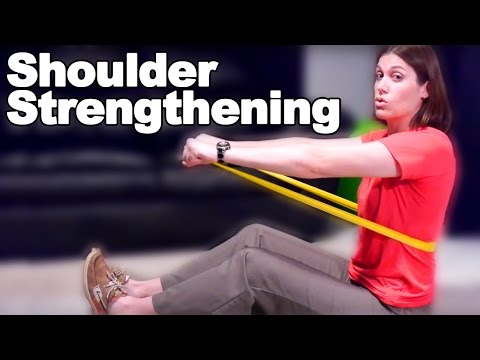
- Anchor a band at eye height somewhere at home. Face pulls are the highest-value thing here and they take ninety seconds
- Do the doorway stretch at three different heights, not just one
- Prioritise the Y in the Y-T-W-I. Lower trapezius is the muscle a desk job switches off most reliably
- Aim for consistency over intensity. Three short sessions a week beats one long one
- Only stretch. Stretching the chest without strengthening the back gives you about twenty minutes of relief
- Yank your head sideways in the trap stretch. Let the weight of your arm do it
- Chase a perfect upright posture all day. Nobody holds it and it is not the point
- Add weight to the Y-T-W-I early. Most people cannot do these properly with bodyweight yet
Lower Crossed Syndrome
The bottom half of the same story. Hours of sitting keeps the hip flexors in a shortened position and the glutes switched off underneath you. The pelvis tips forward — that forward tip is what people mean by anterior pelvic tilt — the low back arches to compensate, and the whole thing crosses over just like the upper pattern.
- Hip flexors, iliopsoas and rectus femoris at the front of the hip
- Low back extensors, the muscles either side of the lumbar spine
- Quadriceps, especially in cyclists and heavy sitters
- Gluteus maximus, literally sat on all day
- Gluteus medius, the side of the hip
- Deep abdominals, the ones that hold the pelvis level
- Hamstrings in some people, though these are often tight-feeling rather than truly short
Anterior Pelvic Tilt
The name for the pelvis tipping forward, and the part of this pattern people are most often told they have.
Picture your pelvis as a bowl of water. Anterior pelvic tilt is the front rim dropping, so the water pours out in front of you. It is the hip half of the pattern above: short hip flexors pull the front of the pelvis down, the glutes and deep abdominals are not strong enough to pull it back up, and the low back has to arch to keep your eyes level with the horizon.
That arch is where the strain argument comes from. Living at the very end of your extension range loads the small facet joints at the back of the spine, and the long muscles either side of the lumbar spine never really switch off. It is also why the ache tends to be a dull, bilateral, end-of-day low back tiredness rather than a sharp one-sided pain, and why it eases when you sit down or bend forward.
Almost every article on this will tell you flatly that anterior pelvic tilt causes low back pain. The honest version is messier. A 2024 meta-analysis did find that pelvic tilt tends to be greater in people with back pain, so it is not nothing — but those studies cannot tell you which came first, and plenty of people walk around with a pronounced tilt and no symptoms whatsoever. Pain changes how you stand, so the tilt may be a consequence as much as a cause.
What that means in practice: do not chase a number. Nobody needs to measure your pelvis, and there is no target angle to hit. If the front of your hips is tight, your glutes are not pulling their weight and your low back is tired by four in the afternoon, the same three things help either way — lengthen the hip flexors properly, get the glutes and deep abdominals strong, and stop holding one position for hours. And if you have the tilt and nothing hurts, you do not have a problem that needs solving.
The floor test. Lie flat on your back on a hard floor with your legs straight, and slide a flat hand under your low back. A hand that slips through with a little room to spare is normal. If the whole hand passes easily with space above it, or you can make a fist and still get it under, you live in more arch than most people do.
The bridge test. Lie on your back and do a glute bridge. If you feel it mostly in your hamstrings or your low back cramps, the glutes are not doing their share.
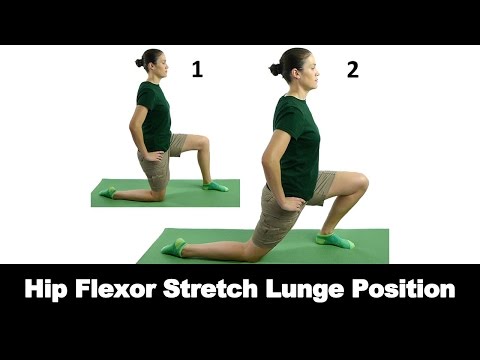
The lunge test. Get into a half-kneeling position and tuck your tailbone under before you press forward. If you already feel a strong pull at the front of the hip before moving an inch, the hip flexors are short.
Stretch these
Daily. The tailbone tuck is the whole trick on the hip flexor one.
 Watch demo
 Watch demo
 Watch demo
Strengthen these
Three times a week. Control matters more than reps.
 Watch demo
 Watch demo
 Watch demo
 Watch demo
 Watch demo
 Watch demo
 Watch demo
- Tuck the tailbone before every hip flexor stretch. Without it you are just arching your back
- Squeeze the glutes hard at the top of every bridge and hold for two seconds
- Stand up and do ten standing hip extensions at the kettle. It counts
- Learn where neutral is with pelvic tilts before worrying about anything else
- Do endless crunches. They reinforce the flexed shape you already sit in all day
- Stretch your hamstrings constantly because they feel tight. Tight-feeling hamstrings are often already long and overstretched by a tipped pelvis
- Arch your low back to feel a bigger stretch at the hip
- Sit on a wallet. One side of your pelvis will thank you
The Two-Minute Desk Reset
No equipment, no floor, no changing clothes. You can do all five of these at an open-plan desk, in a meeting room or in a lecture hall without anyone really noticing. Set a reminder for once an hour. Frequency matters more than duration here, and two minutes every hour beats twenty minutes once.
Before anything else, just stand. Getting out of the chair is doing most of the work, and everything below is a bonus.
20 secondsDraw your chin straight back to make a double chin, hold three seconds, release. Do not tip your head down. This resets the neck after an hour of screen-craning.
10 repsForearms on a door frame, or both hands on a corner, and lean through. If you are stuck at a desk, clasp your hands behind your back and lift.
30 secondsPull the shoulder blades back and slightly down, hold three seconds, release. Completely invisible in a meeting.
10 reps · hold 3sDraw one leg straight back without arching, ten each side, then walk to fill a water bottle. The walk is not filler, it is the most valuable part.
10 each side + a short walkThe problem with sitting is not the shape you sit in, it is how long you stay in any one shape. Muscles get stiff and uncomfortable when they hold a position without variation, and that is true of a perfectly upright posture too. People who sit “correctly” for three hours straight still get sore.
That is why the single most useful habit is not a better chair or a better posture, it is changing position often. Stand for a call. Sit differently. Cross and uncross your legs. Move to a different chair. The best posture really is the next one.
- Set an actual recurring reminder. This habit fails on memory, not on motivation
- Stand up first, even on the days you skip the other four
- Take the short walk at the end. It is the most valuable thirty seconds of the two minutes
- Draw the chin straight back, keeping your eyes level
- Do it on the days nothing hurts. Waiting until you are sore is missing the point
- Save it all up for one long session after work. Hourly beats heroic
- Force a big range on any of these. They are resets, not stretches you need to feel
- Tip your head down during chin tucks. That is a different movement and it does nothing
- Arch your low back to get the leg further back on the hip extension
- Skip it because you have a good chair. The chair is not the variable that matters
Set Up Your Desk In Five Minutes
Getting the setup roughly right removes the constant low-level effort of holding yourself in an awkward position. It will not fix pain on its own, but it makes every other thing on this page work better. Rough and close beats precise and never done.
The top of the screen should sit roughly level with your eyebrows, about an arm’s length away. A stack of textbooks works as well as a monitor stand and costs nothing.
Top of screen = eyebrow levelChair height so your elbows rest at about ninety degrees with the shoulders relaxed down. If the armrests push your shoulders up, lower them or take them off.
Elbows ~90°, shoulders downFeet flat on the floor with knees about level with your hips. If your feet dangle, a box or a ream of paper under them makes a real difference.
Knees level with hipsA laptop forces a choice between a good screen height and a good hand position, so you cannot win. Raise the laptop to eye height and use a separate keyboard and mouse. If a laptop is your main computer, this is the single highest-value change on the page.
Riser + external keyboardKeep the mouse next to the keyboard, not out to the side. Wrists flat or angled slightly down, never cocked upward.
Mouse within easy reachIf you use both equally, put the join in front of your nose. If one is primary, put that one directly in front of you and angle the second.
Primary screen dead centreStanding desks are not a cure. Standing all day produces its own set of problems, and the research on standing desks reducing pain is genuinely mixed. What helps is alternating. If you have one, change position every half hour or so rather than picking a side.
You do not need an expensive chair. A cushion behind the low back and a box under the feet fixes most of what a costly chair is sold to fix. Spend the money on a monitor riser and an external keyboard first.
- Get it roughly right today rather than perfectly right never
- If you only change one thing, raise the laptop and add a separate keyboard and mouse
- Put something under your feet if they dangle. A ream of paper is fine
- Get up for lunch. Eating at your desk is the most common way an eight-hour sitting day becomes a nine-hour one
- Alternate sitting and standing if you have the option, roughly every half hour
- Buy the expensive chair first. A cushion behind the low back and a box under the feet fix most of what it is sold to fix
- Stand all day. Standing has its own set of problems and the research on standing desks is genuinely mixed
- Work off a bare laptop on a table for hours. It forces either a bent neck or bent wrists and you cannot win both
- Push the mouse out past the far side of the keyboard
- Expect the setup on its own to fix pain. It removes the friction, the strength work does the rest
At The Office
And On Campus
The exercises are the same wherever you sit, but the obstacles are not. An office throws back-to-back meetings, a commute, and lunch eaten one-handed over a keyboard at you. Campus throws furniture you did not choose, a laptop as your only computer, and study blocks that run past midnight. Here is what actually moves the needle in each.
If you work at an office
The five changes that make the biggest difference to a forty-hour week at a desk.
The easiest habit to actually keep, because it costs nothing and nobody on the other end can tell. If the call does not need your screen, walk while you take it. Six calls a day is most of an hour out of the chair.
Free, and it adds up fastNot a sticky note. A recurring two-minute block at the top of the hour, or a standing meeting you literally take on your feet. That three o’clock ache across the shoulders is what you are heading off. The people who keep this up are the ones who put it in the calendar.
2 minutes, hourlyEating at your desk quietly turns an eight-hour sitting day into a nine-hour one. Take the food to the kitchen, a bench, anywhere that is not your chair. It is the largest block of movement available in a normal workday and it costs you nothing.
20 to 30 minutes off the chairA 40-minute drive each way is another 80 minutes of sitting on top of the workday. Slide the seat so your hips are level with or slightly above your knees, and put a small cushion behind your low back.
Commute counts as sittingThree hours of calls without standing up is worse for you than a bad chair. End meetings at 25 and 50 minutes instead of on the hour and you buy yourself five minutes to get up, every single time.
End at :25 and :55If you’re a student
Campus adds its own set of problems. These are the ones worth solving.
Working on a laptop on a bed, a low dorm desk or a cafe table puts your neck in the worst position available. A twenty-dollar riser and a cheap external keyboard will do more for your neck than anything else on this page.
Riser + keyboard, under $40One strap loads one side of your spine and shoulder for the entire walk across campus. Use both, tighten them so the bag sits high on your back, and keep it under about 10 to 15 percent of your body weight.
Under 10 to 15% of bodyweightSo adjust yourself instead. Roll up a hoodie behind your low back, put your bag under your feet if the chair is too tall, and move seats every hour or two.
Hoodie + bag = free ergonomicsLong study blocks are when this catches up with people. Set a timer for fifty minutes, then stand and do the two-minute reset. You will retain more too, which is a nicer argument than the neck one.
50 on, 2 minutes movingPoor sleep and high stress predict neck and back pain better than posture does. During exam season, the most effective thing on this list might genuinely be going to bed.
7 to 9 hoursHow To Know If
You’re Doing Too Much
These apply to everything on this page.
Mild discomfort during a stretch or an exercise is fine. Pain above about a 3 out of 10 is not. Reduce the range or the resistance rather than pushing through it.
You should be back to normal within a day. If you are more sore the next morning, halve the volume and build back up. New exercises often cause some muscle soreness for the first week, which is different from joint or nerve pain.
Signs You Should
Get It Looked At
Desk-related aching responds to the work on this page. These are the things that do not, and they deserve an exam rather than more stretching.
Posture
Questions
Less than you have probably been told, though it depends which part of “posture” you mean. The shape you hold is a weak predictor. A study of over a thousand teenagers found no meaningful relationship between spinal posture and neck pain, and forward head posture on its own does not separate the people who hurt from the people who do not. How long you hold it is a different story. Hours in the same position genuinely does shorten some muscles and switch others off, which is the upper and lower crossed pattern, and that is worth doing something about. So the best predictors of pain are how long you stay in one position, how much strength and endurance the supporting muscles have, and things like sleep, stress and overall activity. That is good news, because every one of those is more changeable than the shape of your spine.
A common pattern in people who sit at screens: the chest, upper trapezius and levator scapulae become short and overworked, while the mid and lower trapezius, rhomboids, serratus anterior and deep neck flexors become long and weak. The tight and weak muscles form a cross when drawn on the body, which is where the name comes from. The fix is stretching the front and, more importantly, strengthening the upper back.
The same idea in the lower half. Prolonged sitting shortens the hip flexors and low back extensors while the glutes and deep abdominals get weak, tipping the pelvis forward and increasing the arch in the low back. The fix is hip flexor stretching done properly, with the tailbone tucked, plus glute and core strengthening.
They are one of the best options. Face pulls train the mid and lower trapezius, rhomboids and the external rotators of the shoulder, which is precisely the group that a desk job switches off. Anchor a band at about eye height, pull toward your face with your elbows high, and finish with your hands beside your ears. Three sets of fifteen, three times a week.
Not on their own, and the research on them reducing pain is mixed. Standing all day creates its own problems, including foot, knee and low back discomfort. The benefit comes from alternating rather than from standing itself, so if you have one, change position every half hour or so instead of committing to standing all day.
Most people notice less end-of-day stiffness within two to three weeks, and meaningful strength change takes six to eight weeks. Trials of corrective exercise programs in office workers typically run eight weeks and show reductions in neck and shoulder pain. Consistency matters far more than intensity, so three short sessions a week that you actually do will beat an ambitious plan you abandon.
Almost always because the tailbone is not tucked. In a half-kneeling position, most people arch the low back to push the hips forward, which moves the stretch into the spine instead of the hip. Tuck the pelvis under first, squeeze the glute on the kneeling side, and only then shift forward slightly. It will feel like a much smaller movement and a much stronger stretch.
Generally no, at least not as the main strategy. A brace holds you in a position rather than building the strength to hold it yourself, and the effect disappears when you take it off. Some people find one useful as a short-term reminder, but the muscles doing the work is what produces lasting change.
Yes, and the useful part is figuring out which bit is actually driving your symptoms rather than treating posture generically. Dr. Loewenstein assesses how your neck, mid back, shoulders and hips are moving and loading, uses hands-on care to restore motion in the stiff segments, and builds the specific strengthening that holds the change. Treatment starts on the first visit at the UTC San Diego office, which is a few minutes from UCSD.
Stop Ending The Day
With A Sore Neck
If you have been doing the work and it still aches, there is usually one specific stiff or irritated area driving it. Finding that is what a first visit is for, and treatment starts the same day. Evening and Sunday appointments available, which helps if you are working or in class all week.