Jordan Loewenstein, D.C. | La Jolla Chiropractor
Shoulder Pain
By Location
Pick the part of your shoulder that hurts. You’ll get the conditions that actually live there, the clues that tell them apart, and the specific stretches and exercises for each one.
Where Does It
Actually Hurt?
Shoulder pain sorts out faster than most people expect. Pain on the outer arm that catches halfway up is a different problem from a pinpoint sore bump on top, and both are different from a deep ache that wakes you at 3am. Pick your spot below, read the clues, then open the program that matches.
Two questions do most of the work here. Can you sleep on that side? and can someone else move the arm further than you can? Night pain points toward the rotator cuff or a frozen shoulder. Motion that is limited even when the arm is relaxed and someone else is moving it points strongly at a frozen shoulder rather than a tendon problem. Keep both in mind as you read.
Pick Your
Sore Spot
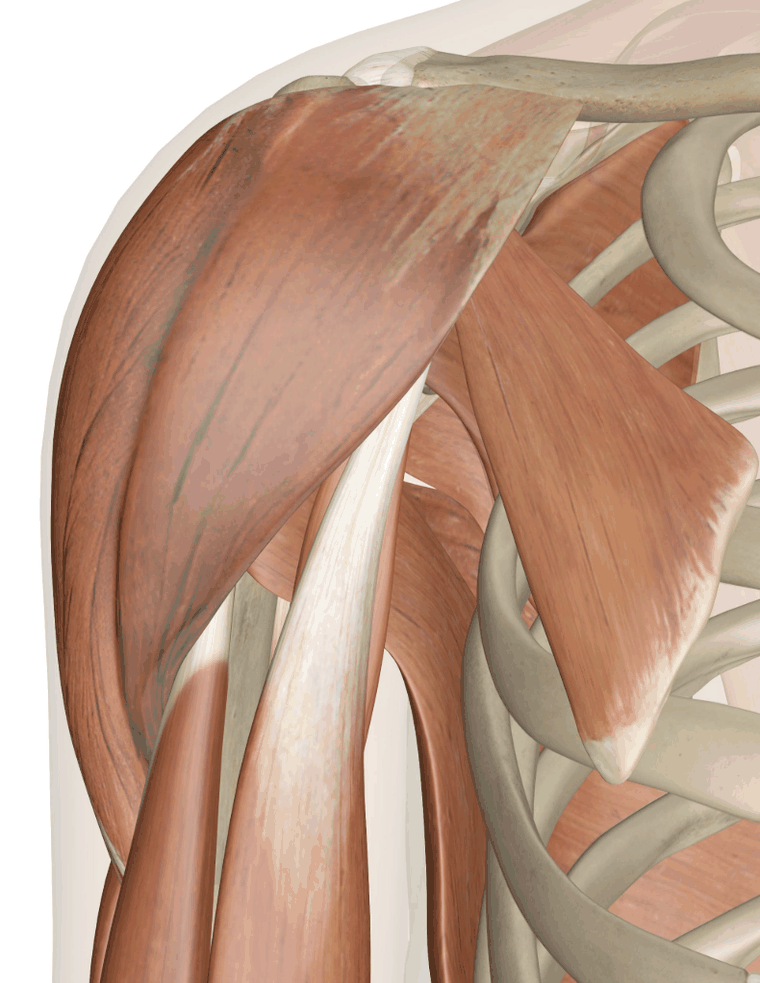
Pick the spot on your shoulder that hurts. You’ll get the conditions that live there, the clues that tell them apart, and the stretches and exercises for each one.
The Outer Shoulder and Upper Arm
This is where most shoulder pain lives. It usually sits on the outside of the shoulder and runs down into the upper arm, sometimes as far as the elbow but almost never past it. Nearly all of it involves the rotator cuff and the narrow space it runs through.
Narrow It Down
Four problems share this address. What separates them is weakness, suddenness, and whether it wakes you at night.
- A painful arc: raising the arm hurts between about 60 and 120 degrees, then eases at the top
- Reaching overhead, or behind you into a jacket sleeve, reproduces it
- Lying on that side at night is uncomfortable
- Strength is close to normal once you work past the pain
- 01Codman Pendulum30 to 60 seconds each direction
- 02Cross-Body StretchHold 30s · 3x
- 03Doorway Pec StretchHold 30s · 3x
- 01Band External Rotation3 sets of 12
- 02Scapular Squeezes3 sets of 12 · hold 3s
- 03Band Scaption & Rows3 sets of 12
- 04Table Slides2 sets of 10
- Keep using the arm below shoulder height. Total rest stiffens it up
- Load the cuff three times a week. Bands are enough, this is a strength problem
- Sleep with a pillow hugged under the sore arm to take the stretch off it
- Do overhead presses, behind-the-neck pulldowns or upright rows while it is angry
- Get a cortisone shot and go straight back to whatever caused it
- Expect it gone in three weeks. Give it eight to twelve
- It hurts through most of the range, not just one arc
- Sharp rather than dull, and it can throb at rest
- It flared after a burst of overhead work like painting a ceiling
- Very tender to press on the outer point of the shoulder
- 01Codman Pendulum30 to 60 seconds each direction
- 02Cross-Body StretchHold 30s · 3x
- 01Band External Rotation2 sets of 12 · light
- 02Scapular Squeezes3 sets of 12 · hold 3s
- 03Table Slides2 sets of 10
- Calm it down first with pendulums and gentle range, then start loading
- Ice 10 to 15 minutes after activity while it is still sharp
- Work below shoulder height for the first week or two
- Push into sharp pain hoping to break through it
- Do repeated overhead work until the sharpness settles
- Stop the strengthening as soon as it feels better. That is how it returns
- You cannot hold the arm out to the side. It drifts down even after someone lifts it there for you
- The weakness is obvious, not just guarding against pain
- It started with a fall, a catch, or a heavy lift
- Night pain is significant
- 01Codman Pendulum30 to 60 seconds each direction
- 02Cross-Body StretchHold 30s · 3x
- 01Band External Rotation3 sets of 12 · light
- 02Scapular Squeezes3 sets of 12 · hold 3s
- 03Prone I-T-W-Y2 sets of 8 each letter
- Get it examined. Tears are graded and the grade changes the whole plan
- Start gentle range and shoulder blade work in the meantime
- Know that most partial tears do well without surgery
- Load it heavily overhead before someone has tested the strength
- Assume the weakness is only pain holding you back
- Wait months if the arm genuinely will not lift
- It came on suddenly and intensely with no injury to explain it
- The pain is wildly out of proportion to anything you did
- You can barely move the arm in any direction
- Typically somewhere between 30 and 60 years old
- 01Codman Pendulum30 to 60 seconds each direction, several times a day
- 01Scapular Squeezes2 sets of 10 · gentle
- 02Band External Rotation2 sets of 10 · very light, once the acute phase settles
- Get seen. This phase often needs medical management and imaging confirms it
- Pendulums and gentle motion only for the first few days
- Know the acute phase usually settles within days to a couple of weeks
- Try to stretch or strengthen through the acute phase
- Assume you have torn something
- Just suffer through it. This is one where medical help genuinely shortens the misery
The painful arc test. Slowly raise your arm out to the side. If pain appears around 60 to 120 degrees and then eases as you keep going up, that is a classic cuff and bursa pattern.
The night test. Can you sleep on that side? Consistent night pain moves the rotator cuff and frozen shoulder up the list, and moves simple muscle strain down it.
The drop-arm test. Have someone lift your arm out to shoulder height and let go. If it drops, or you cannot lower it under control, that is weakness rather than pain and it needs an exam.
- Keep the arm moving below shoulder height. A shoulder that stops moving gets stiff quickly, and stiffness is harder to fix than soreness.
- Change how you sleep. Lie on the good side with a pillow hugged in front to support the sore arm, or sleep semi-reclined.
- Rearrange your reach. Move the everyday things out of the top cupboard for a few weeks.
- Load it three times a week. Bands are plenty. The cuff responds to consistent loading, not to rest.
- Give it eight to twelve weeks. Cuff problems are slow. The people who do well are the ones still doing their bands in week six.
You cannot lift the arm at all, it gave out suddenly after a fall, or there is real weakness rather than pain. That needs an exam before any program.
The Front of the Shoulder
Front-of-shoulder pain is usually one of two things: a biceps tendon running through its groove, or the front part of the rotator cuff. Both respond well. The one worth catching early is instability, because that one is made worse by the stretching most people instinctively do.
Narrow It Down
The front is a small area, so which movement reproduces it matters more than exactly where your finger lands.
- Pressing that groove reproduces your exact pain
- Lifting something palm-up, or reaching straight forward, sets it off
- Carrying a bag or a car seat aggravates it
- Often travels a short way down the front of the arm
- 01Doorway Pec StretchHold 30s · 3x
- 02Cross-Body StretchHold 30s · 3x
- 03Codman Pendulum30 to 60 seconds each direction
- 01Band External Rotation3 sets of 12
- 02Scapular Squeezes3 sets of 12 · hold 3s
- 03Band Scaption & Rows3 sets of 12
- Load it slowly. Tendons want progressive work, not rest
- Carry things closer to your body and with the palm turned in
- Build the rotator cuff too. The biceps tendon usually gets overloaded because the cuff is not doing its share
- Do heavy palm-up curls or front raises while it is irritable
- Stretch it aggressively at the front of the shoulder
- Ignore it for months. It often signals a cuff problem behind it
- Tucking in a shirt or reaching for a back pocket is the worst movement
- Pushing your palm into your belly with force feels weak or sore
- Reaching behind the back is limited compared to the other side
- Often follows a fall on an outstretched arm
- 01Doorway Pec StretchHold 30s · 3x
- 02Sleeper StretchHold 30s · 3x
- 03Codman Pendulum30 to 60 seconds each direction
- 01Band External Rotation3 sets of 12
- 02Rotator Cuff Band Set2 rounds
- 03Scapular Squeezes3 sets of 12 · hold 3s
- Work internal and external rotation both. The cuff is a ring, not a single muscle
- Regain reach-behind-the-back range gradually
- Keep loads close to the body while it settles
- Force the arm behind your back to stretch it
- Bench press heavy through the painful range
- Assume it is just a strain if there is real weakness
- There is a feeling of apprehension when your arm is out and rotated back, like in a throwing position
- You are younger, or you play an overhead or contact sport
- Clicking, catching, or an occasional dead-arm feeling
- Possibly a previous dislocation or subluxation
- 01Codman Pendulum30 to 60 seconds each direction
- 02Cross-Body StretchHold 30s · 3x
- 01Band External Rotation3 sets of 12
- 02Scapular Squeezes3 sets of 12 · hold 3s
- 03Prone I-T-W-Y2 sets of 8 each letter
- 04Rotator Cuff Band Set2 rounds
- Build the cuff and the shoulder blade muscles. Stability is a strength problem here
- Get it assessed, especially if it has dislocated before
- Strengthen through the mid-range first, then work outward
- Stretch it. A loose shoulder does not need more range
- Do overhead pressing or wide-grip bench while it feels unstable
- Return to throwing or contact before the strength is back
- It happened in a specific moment, usually a heavy bench press or a fall
- There may be bruising or a visible change in the muscle shape
- Pressing movements hurt most
- Stretching the arm backward pulls at the front
- 01Codman Pendulum30 to 60 seconds each direction
- 02Doorway Pec StretchHold 20s · 2x, gentle only once healing
- 01Scapular Squeezes3 sets of 12 · hold 3s
- 02Band External Rotation2 sets of 12 · light
- 03Band Scaption & Rows2 sets of 12
- Rest from pressing for the first week or two, then rebuild gradually
- Get a visible deformity or a loud pop assessed promptly
- Return to bench pressing with light weight and a narrower grip
- Stretch it hard in the first week
- Test it by benching heavy to see if it still hurts
- Ignore a sudden pop with bruising. Full tears need surgical review
Find the groove. With your arm relaxed at your side and the palm forward, press just below the bony point at the front of the shoulder. A tender cord there is the biceps tendon.
The back-pocket test. Reach behind your back as if for a wallet. If that is the limited and painful movement, the front of the cuff is involved.
The apprehension check. Raise your arm out to the side and rotate it back like you are about to throw. A feeling that the shoulder might slip, rather than pain, points to instability and changes the plan completely.
- Keep loads close to your body. Carrying anything out in front multiplies the load on the front of the shoulder.
- Turn your palm in. Palm-up lifting loads the biceps tendon directly. Palm-in takes it off.
- Pause the pressing. Bench press, dips and push-ups can wait two or three weeks.
- Do not stretch a loose shoulder. If it feels unstable rather than tight, stretching makes it worse. Strengthen instead.
- Give tendons time. Eight to twelve weeks of consistent loading is the realistic timeline.
A sudden pop with bruising and a change in the muscle shape, or a shoulder that has actually dislocated. Both need prompt assessment.
The Top of the Shoulder
The top of the shoulder is the easiest region to sort out, because the AC joint is a small target you can put one finger on. If your finger lands on the bony bump, it is that joint. If you find yourself rubbing the slope between your neck and shoulder instead, you are in different territory entirely.
Narrow It Down
One question settles most of this: can you point to it with one finger, or do you rub a whole area?
- You can point to it with one finger and pressing there reproduces it exactly
- It followed a fall onto the shoulder, or a hit in sport
- Reaching across your body to the opposite shoulder is the worst movement
- There may be a visible step or lump at the end of the collarbone
- 01Codman Pendulum30 to 60 seconds each direction
- 02Upper Trapezius StretchHold 30s · 3x each side
- 01Scapular Squeezes3 sets of 12 · hold 3s
- 02Band External Rotation3 sets of 12
- 03Band Scaption & Rows3 sets of 12
- Get a visible step or lump assessed. Separations are graded and grade drives the plan
- Keep the arm moving below shoulder height while it settles
- Rebuild the shoulder blade muscles once the sharp phase passes
- Do the cross-body stretch. It compresses exactly the joint that hurts
- Bench press, dip, or do heavy overhead work for a few weeks
- Sleep on that shoulder while it is acute
- Past about 40, and there was no fall or single event
- Bench press, dips and reaching across the body all aggravate it
- A dull ache that lingers for hours after lifting
- Tender to press, sometimes with a small firm bump
- 01Upper Trapezius StretchHold 30s · 3x each side
- 02Doorway Pec StretchHold 30s · 3x
- 03Codman Pendulum30 to 60 seconds each direction
- 01Scapular Squeezes3 sets of 12 · hold 3s
- 02Band External Rotation3 sets of 12
- 03Band Scaption & Rows3 sets of 12
- 04Prone I-T-W-Y2 sets of 8 each letter
- Change the exercises rather than stopping. Narrow the grip, reduce the depth
- Keep training. Load in a comfortable range is good for an arthritic joint
- Build the shoulder blade and cuff so the joint is better supported
- Do deep dips, wide-grip bench, or the cross-body stretch
- Chase it with stretching. This joint does not need more range
- Assume it means you have to stop lifting. It usually just means adjusting
- A history of heavy pressing, dips, or Olympic lifting
- A deep ache in the end of the collarbone that shows up hours after training
- Tender to press right on the bone
- More common in men in their twenties and thirties
- 01Upper Trapezius StretchHold 30s · 3x each side
- 02Doorway Pec StretchHold 30s · 3x
- 01Scapular Squeezes3 sets of 12 · hold 3s
- 02Band External Rotation3 sets of 12
- 03Band Scaption & Rows3 sets of 12
- Deload the pressing volume substantially for six to eight weeks
- Switch to neutral-grip and floor presses that limit the bottom range
- Get an X-ray if it is not settling. This one shows up on imaging
- Train through it. This is a bone stress problem, not a soft tissue one
- Keep doing deep dips and wide-grip bench
- Expect it to resolve in two weeks. It is slow
- You cannot point at one spot. It is a broad band of aching
- Turning or tilting your neck changes it
- Worse at the end of a desk day, or during stressful weeks
- Shoulder movements themselves are basically fine
- 01Upper Trapezius StretchHold 30s · 3x each side
- 02Doorway Pec StretchHold 30s · 3x
- 03Cross-Body StretchHold 30s · 3x
- 01Scapular Squeezes3 sets of 12 · hold 3s
- 02Prone I-T-W-Y2 sets of 8 each letter
- 03Band Scaption & Rows3 sets of 12
- Fix the desk. Screen at eye height, elbows supported
- Take a two-minute movement break every hour
- Strengthen the mid-back. Stretching alone rarely holds
- Only stretch it. The relief lasts about twenty minutes without strength work
- Sit for three hours straight because you are in flow
- Ignore numbness or tingling running down the arm. That is a different problem
The one-finger test. Put one finger on the sore spot. Landing on the bony bump where the collarbone ends means the AC joint. Rubbing the muscular slope toward the neck means it is coming from the neck and trapezius.
The cross-body test. Reach across your chest and pull the arm toward the opposite shoulder. Sharp pain on top of the shoulder is a strong AC joint sign.
The neck test. Turn and tilt your head away from the sore side. If that changes the pain, your neck is involved and the shoulder may be innocent.
- Skip the cross-body stretch. It is the standard shoulder stretch, and it squeezes the AC joint. If the top hurts, leave it out.
- Narrow your grip. On bench press and push-ups, a narrower grip takes load off the AC joint.
- Lose the deep dips. Dips at depth are the single most provocative exercise for this joint.
- Set the desk up properly. If it is neck referral, the desk is the treatment.
- Get a visible step checked. A lump or step at the end of the collarbone after a fall should be graded.
A visible step or lump at the end of the collarbone after a fall, or pain with numbness and tingling running down the arm.
The Back of the Shoulder and Shoulder Blade
Pain back here splits neatly in two. Either it is genuinely the shoulder, which usually means the back of the rotator cuff in someone who throws or works overhead, or it is coming from the neck and the muscles around the shoulder blade. The tingling question sorts it out fast.
Narrow It Down
Start with the nerve question. Any tingling or numbness below the elbow moves the neck to the top of the list, whatever the shoulder is doing.
- Numbness, tingling or pins and needles below the elbow, especially into the hand
- Looking up, or turning toward the sore side, makes it worse
- Sometimes relieved by putting your hand on top of your head
- The shoulder itself moves fine when you test it in isolation
- 01Upper Trapezius StretchHold 30s · 3x each side
- 02Doorway Pec StretchHold 30s · 3x
- 01Scapular Squeezes3 sets of 12 · hold 3s
- 02Prone I-T-W-Y2 sets of 8 each letter
- 03Band Scaption & Rows2 sets of 12
- Treat the neck, not the shoulder. Chasing the shoulder here goes nowhere
- Get it examined, especially if there is weakness in the hand or arm
- Avoid positions that provoke it while it calms, usually looking up and forward head posture
- Aggressively stretch the neck toward the painful side
- Ignore progressive weakness, dropping things, or numbness that keeps spreading
- Assume a normal shoulder exam means nothing is wrong
- You throw, swim, serve, or do a lot of overhead work
- It hurts most on the deceleration phase, slowing the arm down after a throw
- Tender to press on the back of the shoulder
- Reaching across your body to the opposite side pulls at the back
- 01Cross-Body StretchHold 30s · 3x
- 02Sleeper StretchHold 30s · 3x
- 03Codman Pendulum30 to 60 seconds each direction
- 01Band External Rotation3 sets of 12
- 02Prone I-T-W-Y2 sets of 8 each letter
- 03Scapular Squeezes3 sets of 12 · hold 3s
- 04Rotator Cuff Band Set2 rounds
- Work internal rotation range. Throwers almost always lose it on the throwing side
- Build eccentric strength, slow lowering on every rep
- Cut throwing or serving volume by about a third for two to three weeks
- Return to full-velocity throwing before the strength work is comfortable
- Skip the sleeper stretch. Lost internal rotation is usually part of the problem
- Only stretch. This needs loading too
- An ache that builds over hours rather than a sharp movement-specific pain
- Worst at the end of a long day at a computer
- The shoulder blade may wing out or ride up when you raise the arm
- Better on days you move more, worse on days you sit
- 01Doorway Pec StretchHold 30s · 3x
- 02Upper Trapezius StretchHold 30s · 3x each side
- 03Cross-Body StretchHold 30s · 3x
- 01Scapular Squeezes3 sets of 12 · hold 3s
- 02Prone I-T-W-Y3 sets of 8 each letter
- 03Band Scaption & Rows3 sets of 12
- 04Table Slides2 sets of 10
- Strengthen the mid-back. This is a strength and endurance problem, not a tightness problem
- Break up sitting every hour. Two minutes is enough
- Set the screen at eye height and support the elbows
- Rely on stretching and massage alone. Relief lasts about as long as the session
- Sit for three hours straight
- Expect a quick fix. Postural endurance takes six to eight weeks to build
- You can find a distinct tender knot and pressing it recreates the pain
- It refers upward into the neck or toward the base of the skull
- Stress and poor sleep make it noticeably worse
- Range of motion at the shoulder is normal
- 01Upper Trapezius StretchHold 30s · 3x each side
- 02Doorway Pec StretchHold 30s · 3x
- 03Cross-Body StretchHold 30s · 3x
- 01Scapular Squeezes3 sets of 12 · hold 3s
- 02Prone I-T-W-Y2 sets of 8 each letter
- 03Band Scaption & Rows2 sets of 12
- Use a ball against a wall on the knot for 60 to 90 seconds
- Follow the release with strengthening, or it comes straight back
- Look at sleep and stress. They drive this more than people like to admit
- Dig into it hard for ten minutes. More pressure is not better
- Treat it purely as a massage problem
- Ignore it if it comes with headaches. That is worth a proper look
The tingling question. Any numbness, tingling or pins and needles below the elbow? That points at the neck, not the shoulder, and it changes everything that follows.
The neck test. Turn your head toward the sore side and look up. If that reproduces the pain, the neck is involved.
The internal rotation check. Lying on the sore side with the arm out at 90 degrees, rotate the forearm down toward the floor. Compare sides. Throwers usually lose a lot of range here and that loss drives back-of-shoulder pain.
- Answer the nerve question first. Tingling below the elbow means the neck gets treated, not the shoulder.
- Fix the workstation. Screen at eye height, elbows supported, feet flat. This is treatment, not advice.
- Move every hour. Two minutes of movement beats an hour of stretching at the end of the day.
- Strengthen the mid-back. Scapular squeezes and prone I-T-W-Ys, three times a week.
- Throwers, cut volume. Drop throwing or serving by about a third for two to three weeks while you build the cuff.
Weakness in the hand or arm, numbness that keeps spreading, or you are dropping things. That needs prompt assessment.
Deep In The Joint, Or Waking You Up
When you cup the whole shoulder instead of pointing at it, and especially when it wakes you at night, the list changes. These are the bigger problems. The good news is that one simple test separates most of them, and once in a while the shoulder is not the source at all.
Narrow It Down
The test that matters most here: can someone else move your arm further than you can? If not, think frozen shoulder. If they can, think cuff.
- Chest pressure or tightness, shortness of breath, sweating, nausea or lightheadedness. Call 911.
- The pain comes on with exertion like climbing stairs and eases with rest
- Moving, pressing or positioning the shoulder does not change it at all
- Right shoulder tip pain with belly pain after fatty meals can be the gallbladder
- Treat chest pressure with shortness of breath as an emergency. Call 911, do not drive yourself
- Tell someone if you have risk factors: high blood pressure, diabetes, smoking, family history
- Get right shoulder tip pain with abdominal symptoms evaluated the same week
- Stretch it, ice it, or wait to see if it passes
- Assume it must be muscular because it is in your shoulder
- Drive yourself to hospital
- Someone else cannot move your arm any further than you can. This is the single most useful sign
- Reaching behind your back and rotating the arm outward are the first movements lost
- Between about 40 and 60, and more common with diabetes or thyroid disease
- It hurts badly at night, and it came on gradually with no clear injury
- 01Codman Pendulum30 to 60 seconds each direction, several times a day
- 02Table Slides2 sets of 10
- 03Cross-Body StretchHold 30s · 3x
- 04Sleeper StretchHold 30s · 3x
- 01Band External Rotation2 sets of 12 · light
- 02Scapular Squeezes3 sets of 12 · hold 3s
- Work range of motion daily, little and often. Five minutes four times a day beats twenty once
- Get the diagnosis confirmed. The treatment is genuinely different from a cuff problem
- Understand the timeline: freezing, frozen, then thawing, often 12 to 18 months total
- Force it aggressively in the painful freezing phase. That makes it angrier
- Let the arm stop moving. Motion is the whole treatment
- Expect a quick fix. Steady daily work is what changes this one
- Past about 60, and it has come on gradually over years
- A grinding or grating feeling when you move the arm
- Stiff in the morning, easing after twenty or thirty minutes
- Aches after use and often at night
- 01Codman Pendulum30 to 60 seconds each direction
- 02Table Slides2 sets of 10
- 03Cross-Body StretchHold 30s · 3x
- 01Band External Rotation3 sets of 12
- 02Scapular Squeezes3 sets of 12 · hold 3s
- 03Band Scaption & Rows2 sets of 12
- Keep it moving daily. An arthritic joint stiffens fast when it is spared
- Strength train it two or three times a week within a comfortable range
- Warm it up before activity rather than after
- Rest it because it aches. Stiffness and weakness both accelerate
- Do heavy overhead pressing
- Assume nothing can be done. Strength and range work reliably help
- You cannot raise the arm against gravity, or it shrugs upward instead
- Night pain is severe and consistent
- It may have followed a fall, or built up over years in an older shoulder
- Someone else can move the arm further than you can move it yourself
- 01Codman Pendulum30 to 60 seconds each direction
- 01Scapular Squeezes3 sets of 12 · hold 3s
- 02Band External Rotation2 sets of 10 · very light, only if comfortable
- Get it examined and imaged. Timing matters more with large tears
- Keep passive range going with pendulums in the meantime
- Ask specifically about the difference between a repairable and a non-repairable tear
- Spend six months on exercises before anyone has looked at it
- Load it overhead
- Confuse this with a frozen shoulder. In a frozen shoulder someone else also cannot move it. Here they can
The passive motion test. Let your arm go completely limp and have someone else raise it and rotate it outward. If they cannot move it further than you can, that points strongly at a frozen shoulder. If they can move it much further, the problem is the cuff.
The night test. Consistent pain that wakes you, or stops you sleeping on that side, belongs in this group and deserves a real exam.
The rule-out. Does moving, pressing or repositioning the shoulder change the pain at all? If nothing you do to the shoulder makes any difference, the pain may not be coming from the shoulder.
- Move it every day. With frozen shoulder and arthritis both, daily range work is the treatment. Little and often.
- Sort out sleep. Semi-reclined, or on the good side with a pillow supporting the sore arm in front of you.
- Warm up first. A hot shower before your range work makes it noticeably easier.
- Get a diagnosis. This group is where guessing costs you the most. Frozen shoulder and a cuff tear need opposite approaches.
- Be realistic on timeline. Frozen shoulder is often 12 to 18 months. Knowing that up front makes it much easier to stick with.
Chest pressure, shortness of breath, sweating or nausea. Call 911. Also get seen promptly for an arm you cannot lift at all, fever with a hot swollen shoulder, or pain following significant trauma.
Stretches &
Exercises
Every movement referenced above, in one place, with a video demo. Nothing here should reproduce sharp shoulder pain. Work in the range that feels clean and let it expand week by week. Two rules govern all of it, and they are spelled out right after this section.
Stretches and range of motion
Daily is fine, and in a stiff shoulder little and often beats one long session.
 Watch demo
 Watch demo
 Watch demo
 Watch demo
 Watch demo
 Watch demo
Strengthening
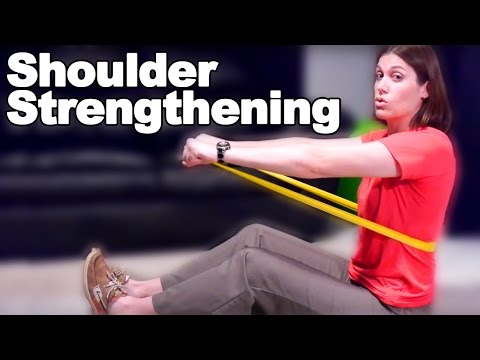
Every other day. A light resistance band is all you need to start.
 Watch demo
 Watch demo
 Watch demo
 Watch demo
 Watch demo
 Watch demo
How To Know If
You’re Doing Too Much
These two rules apply to every program on this page, wherever your pain is. They are the same ones I give patients in the office, and they replace the guesswork about whether to push through something.
Some discomfort during these exercises is normal and even useful. Pain above about a 3 out of 10 is not. If an exercise pushes past that, reduce the range, the band tension, or the number of reps.
Your shoulder should be back to its normal baseline within 24 hours. If it is more sore the next morning, or it kept you awake, you did too much. Cut the volume roughly in half and rebuild from there.
Signs You Should
Skip the Exercises
Almost every shoulder I see does well with the right loading. These are the exceptions.
Shoulder Pain
Questions
Most often rotator cuff tendinopathy, also called subacromial pain syndrome. The giveaway is a painful arc: raising the arm out to the side hurts between roughly 60 and 120 degrees and then eases at the top. It also tends to hurt reaching overhead or behind you, and to bother you when you lie on that side at night. If the arm is genuinely weak rather than just painful, that points instead to a rotator cuff tear.
Night pain is one of the most useful clues in the shoulder. Lying down removes the support the arm normally gets and lets the joint settle in a position that compresses the cuff, and there are no distractions to compete with the pain. Consistent night pain moves rotator cuff problems and frozen shoulder up the list. Try sleeping on the good side with a pillow hugged in front of you to support the sore arm, or semi-reclined.
One test separates it from almost everything else: have someone else move your arm while you keep it completely relaxed. In a frozen shoulder they cannot move it any further than you can, because the joint capsule itself has tightened. With a rotator cuff problem they can usually move it much further than you can. Frozen shoulder typically shows up between 40 and 60, is more common with diabetes, and takes away outward rotation and reaching behind the back first.
If you can cover it with one fingertip and it sits on the bony bump where the collarbone meets the shoulder, that is the AC joint, either sprained after a fall or arthritic if it came on gradually. Reaching across your body makes it worse. If instead you find yourself rubbing the muscular slope between your neck and shoulder, the pain is coming from the neck and trapezius rather than the joint.
Yes, and it is a common miss. The tell is numbness, tingling or pins and needles below the elbow, and pain that changes when you turn or tilt your neck. Cervical radiculopathy, a pinched nerve in the neck, frequently presents as pain around the shoulder blade and back of the shoulder. If that describes you, the neck needs treating and shoulder exercises will not get you far.
It depends on the diagnosis, which is exactly why this page separates them. A stiff shoulder like adhesive capsulitis needs daily range of motion work. A rotator cuff problem needs progressive strengthening more than stretching. A shoulder that feels unstable should not be stretched at all, since it does not need more range. Getting this backwards is one of the most common reasons shoulder pain drags on.
Rotator cuff problems usually need 8 to 12 weeks of consistent loading. AC joint sprains often settle in 4 to 6 weeks depending on the grade. Frozen shoulder is the long one, commonly 12 to 18 months through freezing, frozen and thawing phases. Progress is rarely linear, and week three often feels like nothing is happening. If you are twelve weeks in with no change, get examined.
Get evaluated if you cannot lift the arm at all, there is obvious weakness rather than pain, the shoulder has dislocated, or you have numbness and tingling down the arm. Chest pressure, shortness of breath, sweating or nausea with shoulder pain is a 911 call, not a shoulder problem. Also get seen for a hot swollen shoulder with fever, or pain that follows significant trauma.
Yes. Shoulder pain is often driven by the neck, the mid-back and the way the shoulder blade moves, which is exactly what a full exam looks at. Dr. Loewenstein assesses the shoulder along with everything connected to it, uses hands-on care to restore motion and calm irritated tissue, and builds the loading program that actually resolves it. Treatment starts on the first visit at the UTC San Diego office.
Find Out What’s
Actually Going On
Narrowing it down by location gets you most of the way there. A hands-on exam gets you the rest of the way, and treatment starts on visit one.